
Goodmooooooooorning Belgium. Time to wake up.
BPX, the unified voice of Belgium’s leading publishers (DPG Media, IPM, Mediahuis, Rossel and Roularta), was founded to solve a problem most people keep tiptoeing around: Belgian brands spend their media money elsewhere. 62% of our digital media budgets go to tech giants who don’t know what a “koffiekoek” is and don’t care where “Herenthout” is located.
The ambition was to launch BPX as a credible collective voice for the Belgian publishers, and to shift the conversation from vanity KPIs to real impact: attention, trust, context. The target was broad on purpose: CEOs, CMOs, marketers, agencies, media planners, opinion leaders and policymakers. And there was an additional problem at the beginning: how do you create one voice, knowing most of these media houses have been competing heavily for years?
So how did we end up here?
We decode the culture
We framed BPX and the editors-in-chief as “the Originals”. Where the truth is checked, nuance survives, and communities exist outside the feed. A place where marketing can perform across the full funnel, with transparency and accountability.
The tone was a deliberate choice: direct, Belgian, sharp, sometimes witty, always human. A voice that talks like people talk, so it could show up in a newspaper, on a stage, in a teaser and later in video, without turning into corporate soup.
01
We detect and activate communities
We treated BPX like a community leader and forerunner for Belgian culture instead of yet another federation. First, we did the strategy, positioning and website of BPX, creating their tone of voice, manifest, reason to believe and visual universe. This was an intense period, working closely together with the small BPX team: Gauthier Elslander and Mieke Berendsen.
And we kept that community thinking at the center of everything. Hence the reach-out to the Raad voor Reclame, with whom we published a whitepaper, “The impact of advertising on the Belgian economy”.
02
We design experiences online and offline
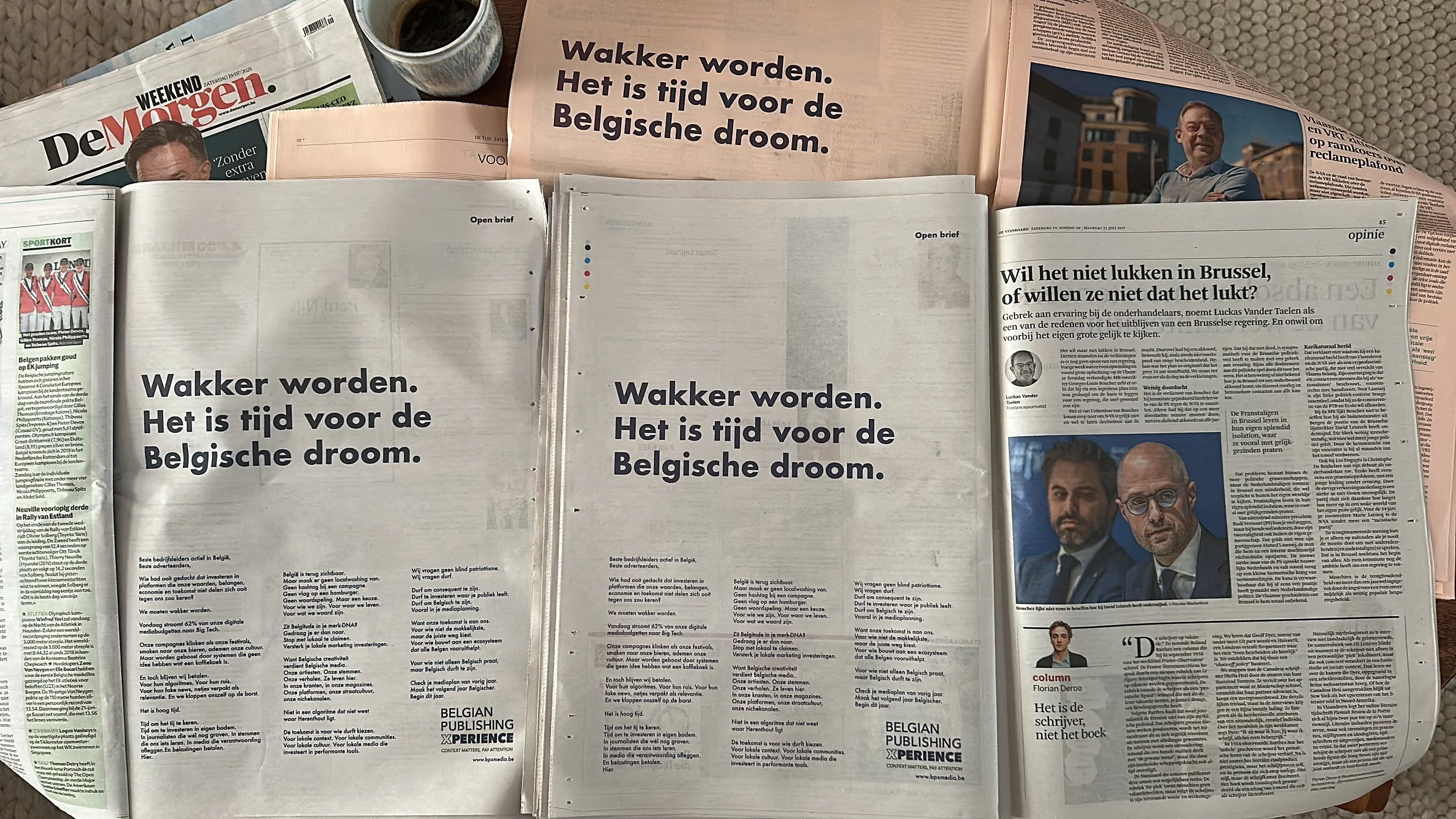
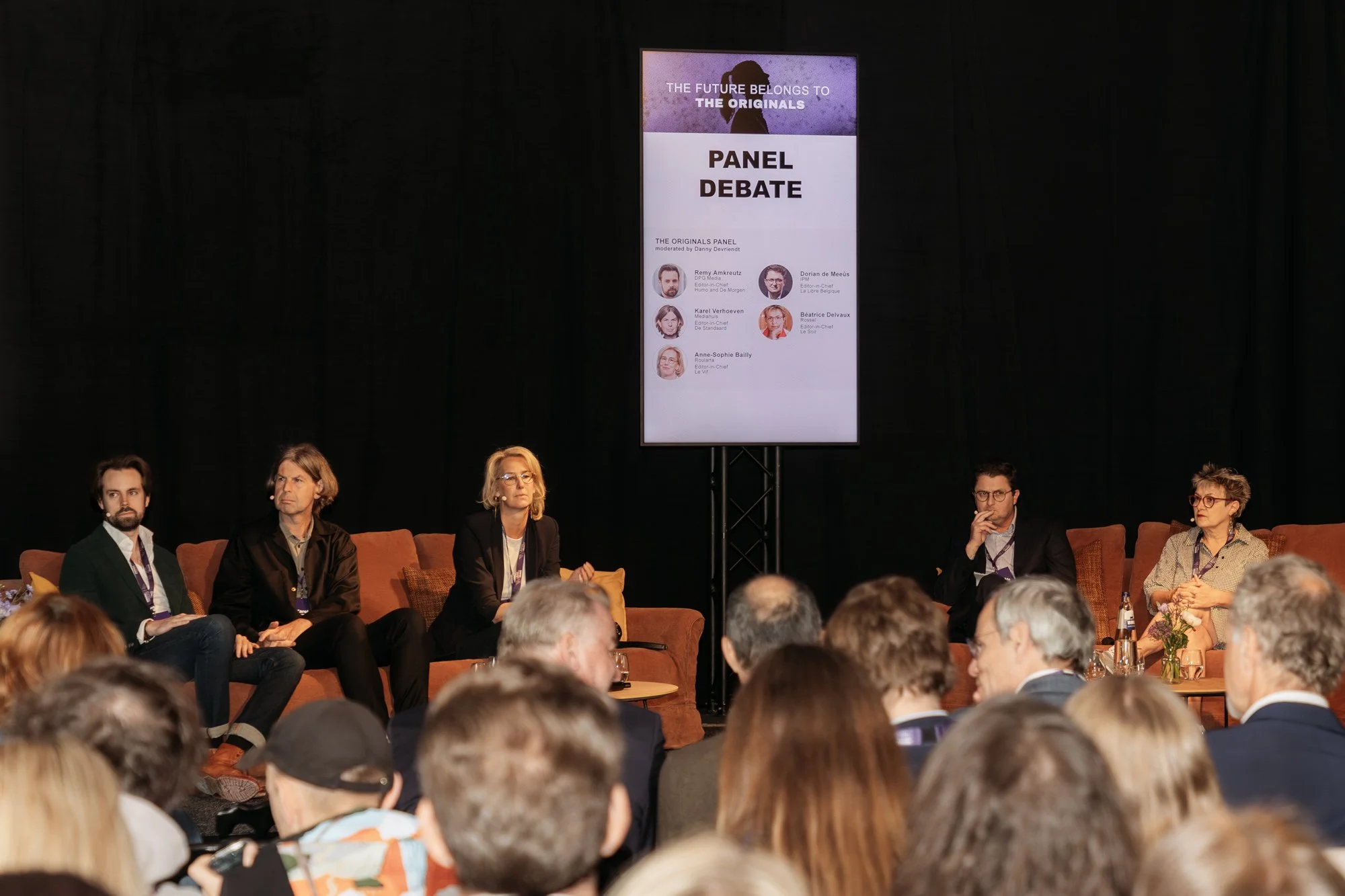
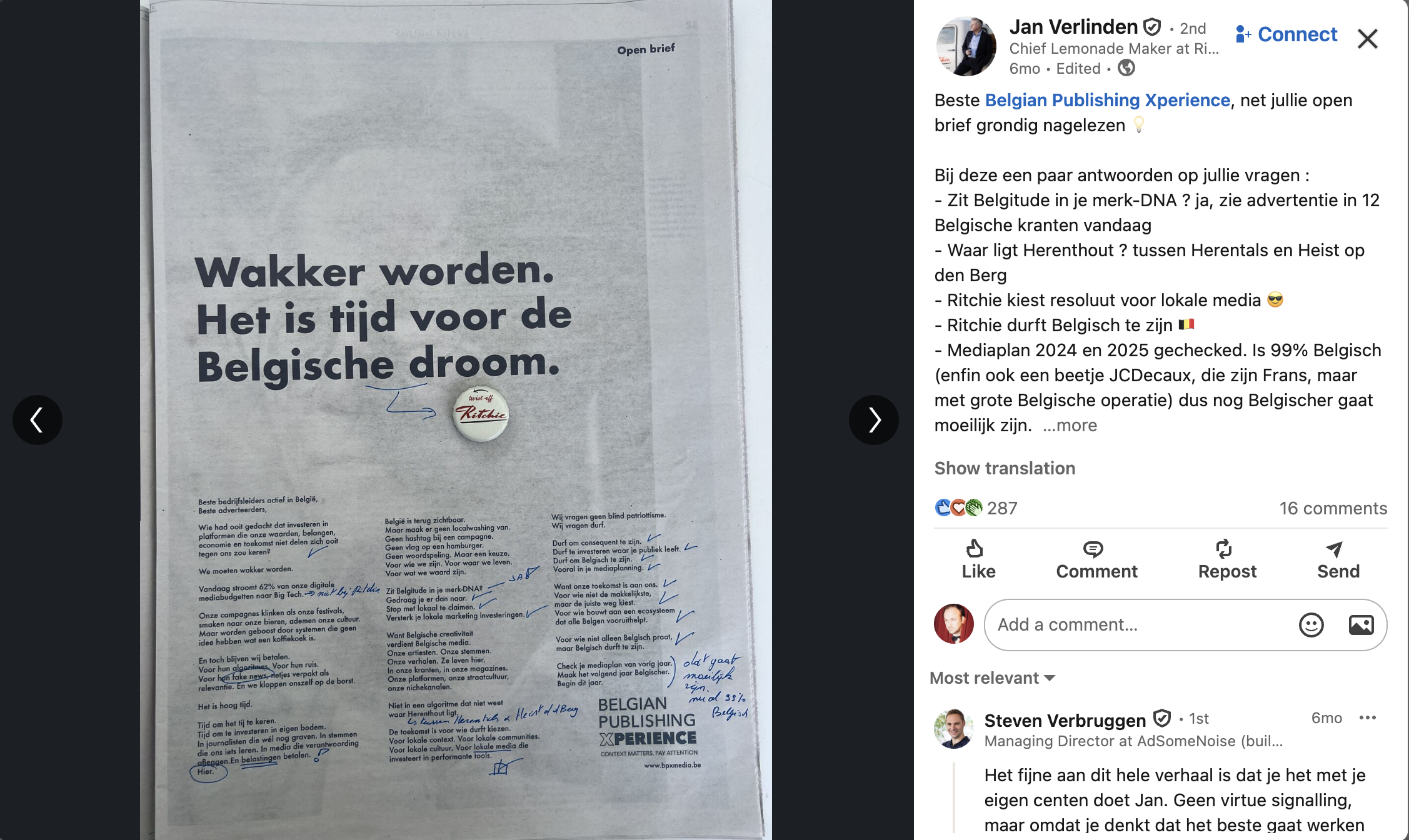
We launched BPX with an event platform that immediately signaled ambition: “The future belongs to the Originals.” The launch was not treated as a one-night press moment, but as the first chapter of a storyline BPX could keep writing for years. To seed that story where the industry pays attention, we placed a teaser in the AMMA booklet, then followed with the first national proof-point: an open letter published across major Belgian newspapers on July 21, the national holiday.
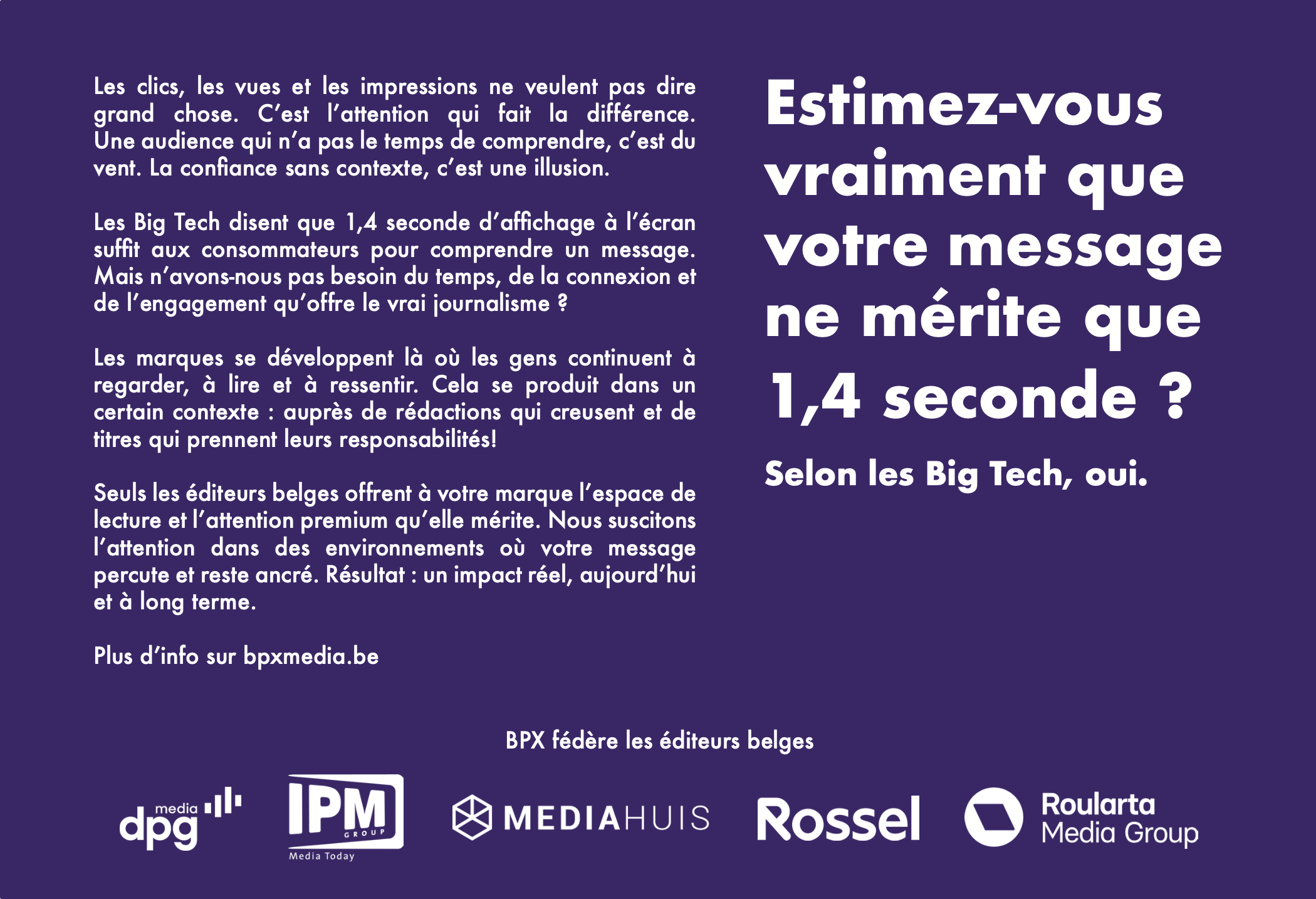
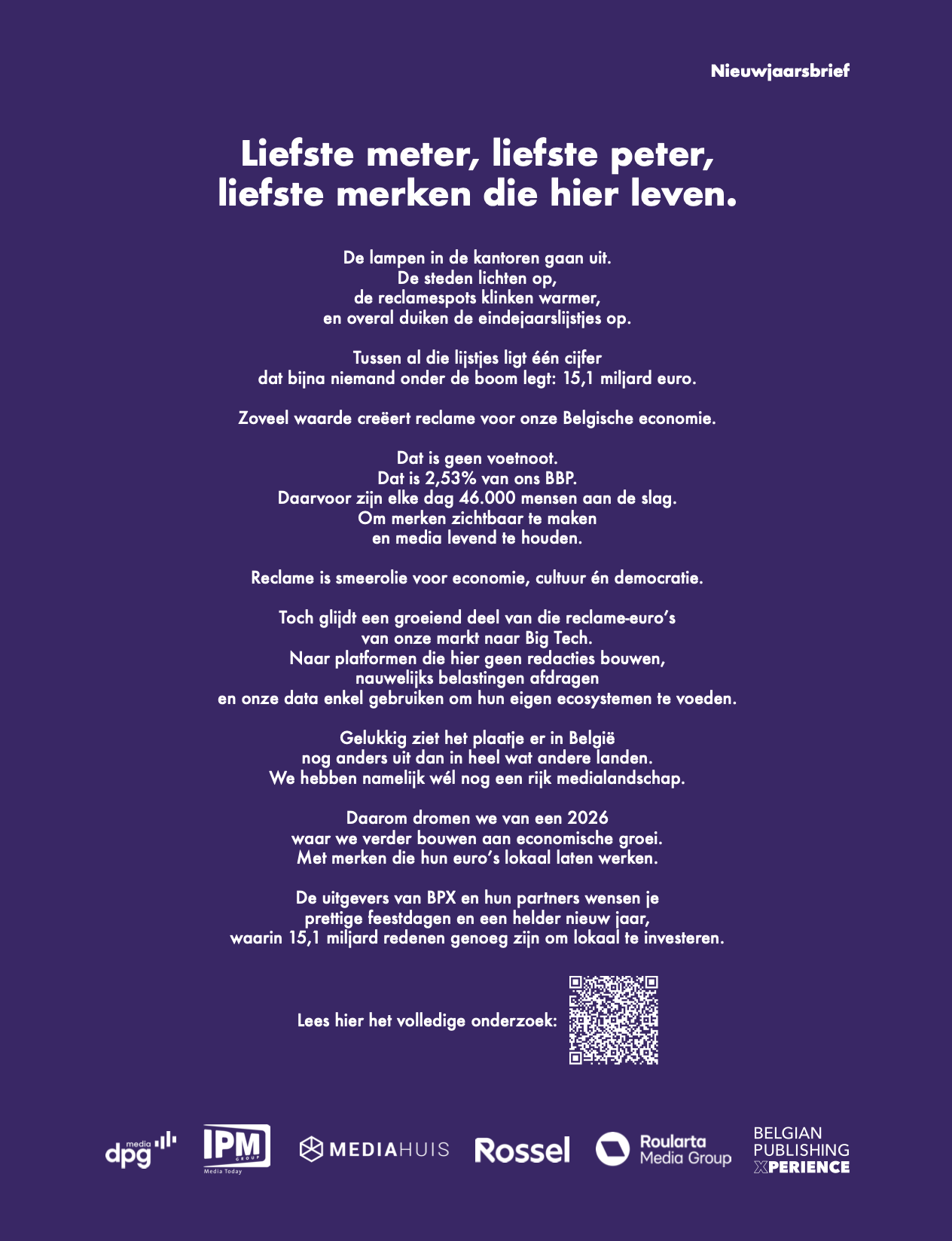
From there, we evolved the platform into repeatable campaign waves. One of the strongest was the attention narrative: the “1.4 seconds” question that exposes vanity metrics as theatre and reframes attention as the growth signal that matters. Another wave leaned into end-of-year cultural ritual, with a print concept celebrating news media as the engine of real conversation, not feeding noise.
03
We build hype
Across each wave, the job stayed the same: keep BPX out of generic Big Tech bashing, keep it sharp, keep it constructive, and always flip the argument into BPX’s strengths: relevance, trust, local context, brand-safe environments, and full-funnel effectiveness that holds up when someone asks real questions at board level.
And the community woke up. Local entrepreneurs and media experts connected and reacted. The first open letter had even our local hero Jan Verlinden, Chief Lemonade Maker at Ritchie, talking on LinkedIn, alongside other cultural voices. Exactly what we aimed for.
04
We generate cultural currency
The work gave BPX instant recognizability, a voice people could quote, and a platform that can keep producing new chapters without restarting every time. It also proves our core belief in practice: brands and institutions win by building soft power. Trust. Permission. Relevance. Belonging. BPX needed a voice that could carry that weight, and a creative system that could keep earning attention without renting it.
05
We measure business impact
BPX went from zero into a coherent cultural position, then into a living comms system that can show up in newspapers, industry moments, timed news hooks and new formats, without losing credibility. But the sharpest signal came from outside the country.
06
The BPX launch created international pull:
a direct request from Rossel France to develop a similar approach for their local newspapers.
A campaign for Belgian media became an export. That is what happens when you build a position instead of a campaign.